Perhaps the greatest leap forward in the recent world of succulent growing is the arrival of "LED lights that offer strong, powerful light." With these, indoor care—which used to be nearly impossible—is now much easier, and rumor has it, growth speed is off the charts... Yes, *the reason you're only hearing those rumors is probably because these lights were so expensive you just gave up even considering them*.
For everyone in that boat—thank you for waiting! We've found ultra-affordable LED grow lights for plants, and we're excited to begin sharing them at our cost. Of course, we're also going to prove to you right here that they provide more than enough performance.
If you've always wanted to try growing succulents under LEDs but couldn't, this is the start of a brand-new chapter. Let's all set off together into this new world of "growing succulents with LED lights." I'll show you the way.
^ PS: We've also added a super compact, budget-friendly high-value model. Be sure to check it out too! ^
Curious about the equipment you'll need, how to set it up, and how to use it? Look here:
From the beginning, the big motivation for LED lights was being able to *grow plants even where sunlight isn't enough*. That's impressive on its own, but nowadays it's really just a minor perk compared to all the other benefits LEDs have to offer.
The biggest headaches with succulent care mostly come from being unable to keep up with the dramatic seasonal changes of summer and winter. Too much water, too much heat, rot, leaf scorching, mushiness, poor dormancy, failure to recover after dormancy, freezing, pests, diseases... That's mainly because Japan's four seasons are so wildly different. But if you care for your plants indoors, changes in temperature aren't nearly as extreme as outdoors, there's no weather to deal with, pests and weeds can't get inside, and you can spot any sudden changes much more quickly. It also makes it way easier to mimic how other growers succeed, since differences between homes become minimal. It really does make succulent care much easier.
This is the biggest benefit of LEDs: you can create an environment that's literally *overflowing* with both light and water—that's honestly like doping for plants. Succulents, which everyone always calls slow growers, suddenly start growing at what seems like an impossible speed.
Do you know how much sunshine we really get naturally? If you imagine 12 hours of daylight from 6am to 6pm, that's 12hr × 30 (days) = 360 hours of sun in a month, but *actual* sunshine hours in Tokyo are often only 160–200 hours—about half that. Some bad months are as low as 120 hours. That's how much Japan really suffers from cloudy weather. And the brightest sunlight is only around noon, so the "amount of intense light your plants soak up" is really only about half what you might expect.
In contrast, LED lights let you fully control how much "daylight" your plants get. Give them 15 hours per day for a year and you get 15 × 365 = 5,475 hours—already 2.7 times Tokyo's yearly 2,000 hours of sun! And since LEDs deliver *maximum* intensity from ON to OFF, as opposed to the rising and fading of natural light, that doubles the amount of high-quality light—making it 5.4 times.
More light means your plants will drink more, but that's no problem: it's easy to keep an eye on them and water as needed indoors. Indoor temperatures are more stable, and you can add a heater or air conditioner. Spring/summer growing succulents basically skip "real dormancy" and grow at max speed year-round. It's like every season becomes spring or fall—doubling your growth period.
So, with 5 times the light and twice the growing season, in theory, plants might grow over 10 times faster than outdoors! It's not *quite* that simple, but there are already tons of success stories out there reporting 2–4 times faster growth as standard, and sometimes even 10 times faster. It's not an exaggeration!
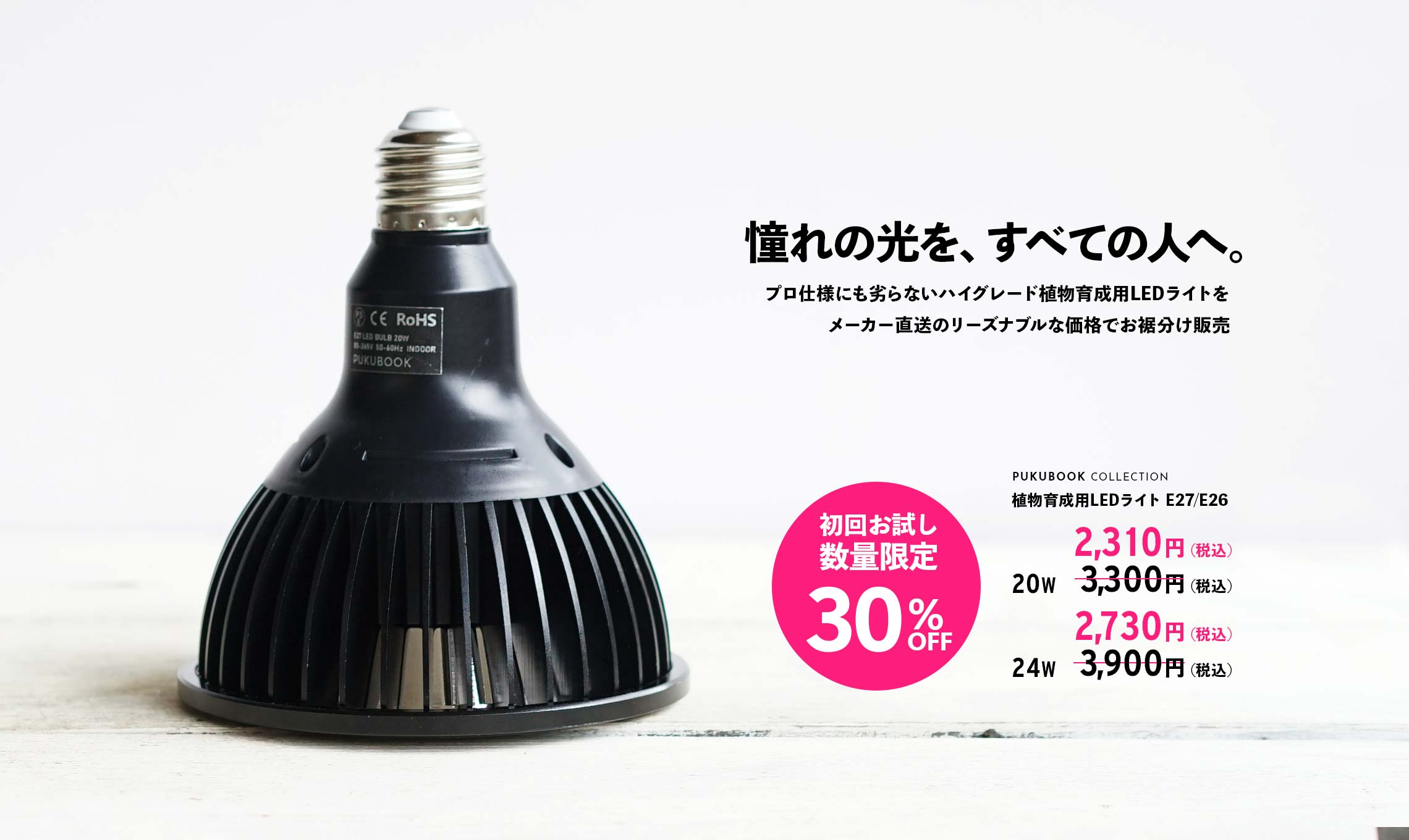
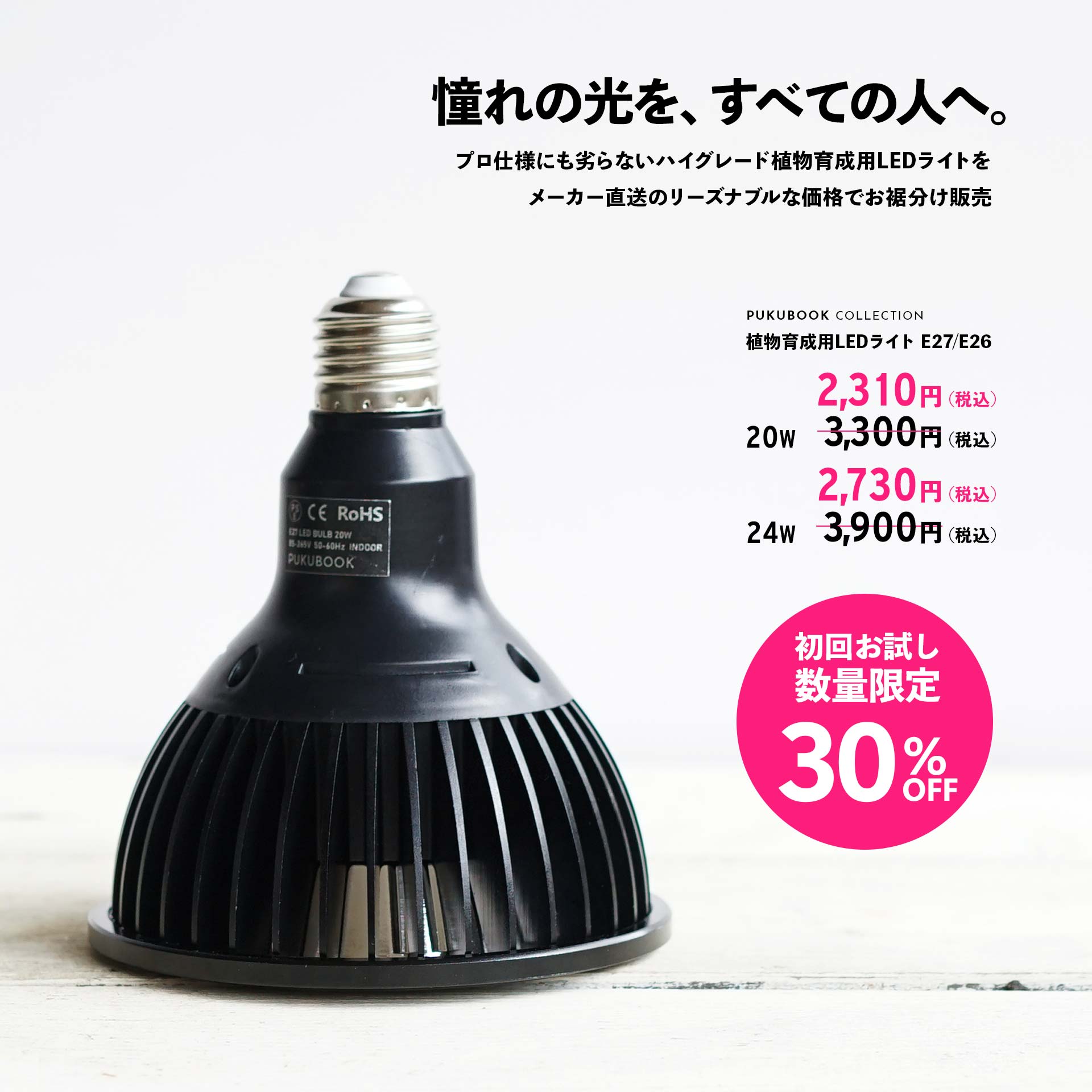
A zero-trouble, tenfold growth environment—sounds like a dream, doesn't it? Absolutely worth trying! ...But aren't LED grow lights expensive? Sure, given the results maybe they're not so pricey after all—but most of us have a limit to our gardening budget. Isn't there something affordable enough that even I could buy it?
I thought so too, and went searching. The answer isn't usually sold in Japan, so we import them! Even after that, with our group ordering and sharing, they're still realistically priced, so they're now available as part of the PUKUBOOK COLLECTION.
Here they are!
First, a quick heads-up... these are, honestly, "lookalikes" (lol).
This particular design? It's actually a *widely available part* marketed as an "LED bulb housing," and there are several manufacturers that make LED bulbs by simply assembling the parts inside. Some of the famous Japanese brands have their own custom versions made by these companies, or buy them as OEMs. That's why you'll see several different brands selling bulbs with the same design.
This is something I especially want to highlight. Just how big is the difference between traditional outdoor care and using LEDs indoors? Take a look—it's eye-opening.
So, do you still want to stick with outdoor care? (wink)
Now let's talk about real comparisons we made ourselves—looking at what difference things like wattage and color temperature make, so you can figure out which one is best for you.
First, spoiler: the one I recommend to everyone (no exceptions) is the 20W Daylight White. If you have really big plants, or you love a challenge, try the 24W Daylight White. If you're focused on warm interior design, the 20W Warm White is great.
We compared six types of LED lights this time:
- Famous Brand A (benchmark)
- 20W Daylight White (same specs as A, testing head-to-head)
- 24W Daylight White (even more powerful)
- 20W Warm White (testing how it compares to daylight)
- Panel Type, Warm White (to compare panel LEDs)
- Panel Type, Red/Blue (older dual-color grow LEDs)
To keep things fair, every box and USB fan was the same size; LEDs turned on 6am–9pm automatically each day; watering timing matched, and amounts were roughly equal by eye.
| Position | 20W Daylight | No Lens | A 20W |
|---|---|---|---|
| Measured wattage | 18W | - | 17W |
- The shape is identical (these casings are sold as components).
- The plastic is a little different; you'll only notice side by side in bright light.
- The LED diodes and electronics inside are unique to each.
- A skips the lens or covering glass.
The measured brightness of our model was actually about double. Product A lacks a lens, so we also tested ours without a lens—without it, light spreads more evenly, lowering the hotspot in the center and increasing brightness around the edges.
As for growth? Honestly, we couldn't tell the difference. With more kinds and sizes of plants over a longer time, maybe you'd see something, but compared to differences from color and wattage, these brand-model differences seem relatively minor.
Brand LEDs aren't just about the hardware—they include the value of research, quality control, aftercare and pre-sale service (store presence, staff knowledge), advertising, plus the *bragging rights* of "owning the top gear" (wink). That's all worth something, and I don't mean to knock it at all! Some folks value that, some would rather skip the extras and just get things cheaper. It's all about having choices!
| Position | 20W Daylight | 24W Daylight |
|---|
Numbers-wise, the increase in brightness isn't huge (maybe 10% more), but *plants definitely react differently*. The 24W often brought out stress colors at usual distances—it seems a bit too much for agaves in 9–12cm pots. It may really shine with giant agaves (15–30cm pots) or varieties like Copiapoa that crave intense sun. In fact, if you use one bulb per pot, even 10W might do (I'm already planning to try those next).
| Position | 20W Daylight | 20W Warm White |
|---|
| Position | 20W Warm White | 24W Warm White |
|---|
LEDs that mimic sunlight use white light as the default. In interior design, though, you'll always hear that pure white light... *isn't restful* (lol). Humans are hardwired to be active under bright white light and relax as the sun turns red and gold (that's why hotels and Western homes tend to use warm tones—though for some reason, white tubes are popular in Japan).
Because I love the look, I *had* to offer warm white ones—but, honestly, these aren't as good for plants. They still work, but compared to daylight LEDs, growth is slower and leaves frequently show red or brownish stress colors.
If you're coordinating your interior and need to light large plants, warm white LEDs will look great. If you're spotlighting a single agave, daylight white gives better results for growth and health.
These LEDs are just that—bulbs—so you'll need a matching socket and stand. Many folks install slide rails ) on their plant shelves, but if you're looking for something simple, a stand is the way to go.
My personal favorite is the Joseph Iron Hook Stand. The size is perfect, it's stylish, and budget-friendly too. I got mine from Monotaro. The only small downside is, since the hook is fixed, plants over 12cm in diameter need a little ingenuity to center the light. They also offer tons of pro-quality display stands, so take a look around.
Any inexpensive socket will work. I used ELPA's cord socket from Monotaro this time—the retro-style rotary switch is cute! Note: there are both E26 and E27 base sizes, but either will fit these bulbs (E17 and other sizes won't).
For more tips on setting up and managing your lights, check out the related guide below:
Right now, *high-brightness LED lights* are the hottest thing in gardening. But honestly, they're still pretty expensive, and I bet many people hesitated just because the price kept them out of reach. I wanted to make it so you'd look at these and think, "Hey, maybe I can actually try it at this price!" That's what I poured into this article's title and tagline.
If you save money on the bulbs, you can invest more in fun stands and accessories too. And if you use more than five bulbs, the total price difference is huge—easily several tens of thousands of yen! I hope you'll enjoy the benefits and flexibility of *having another option*.
CREATIVE COMMONS BY-NC 2026
PUKUBOOK SOME RIGHTS RESERVED.


BenefitFewer ads for a cleaner display♪