Sorry! I know I’m being persistent and a bit obsessed here—but I just can’t help myself with these “LED bulbs.” When there’s something even better, I feel I have to share it! Last time, I delivered the best cost performance under the challenge and pledge to stick with the "famous lookalike" design. But if you remove that constraint, there’s a whole new level of options. In fact, the differences—by not being the same—make these alternatives even better. So with this official debut, here’s my all-out take on what makes this "Alternative Best" so great.
If you’d like to review the intro of that "famous lookalike" and why LED bulbs are needed, check the column below.
For info on required equipment, setup methods, and how to use them, see here.
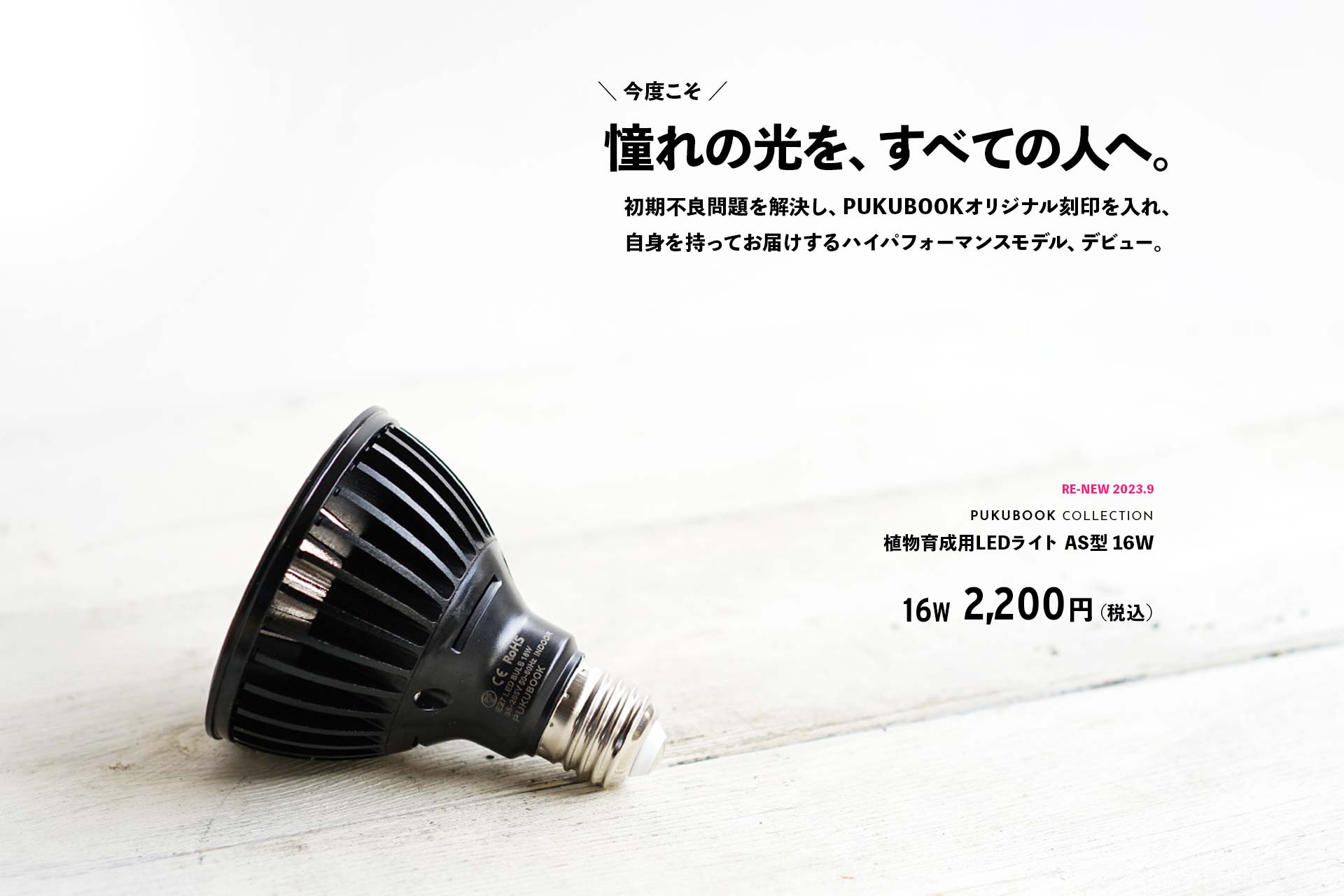
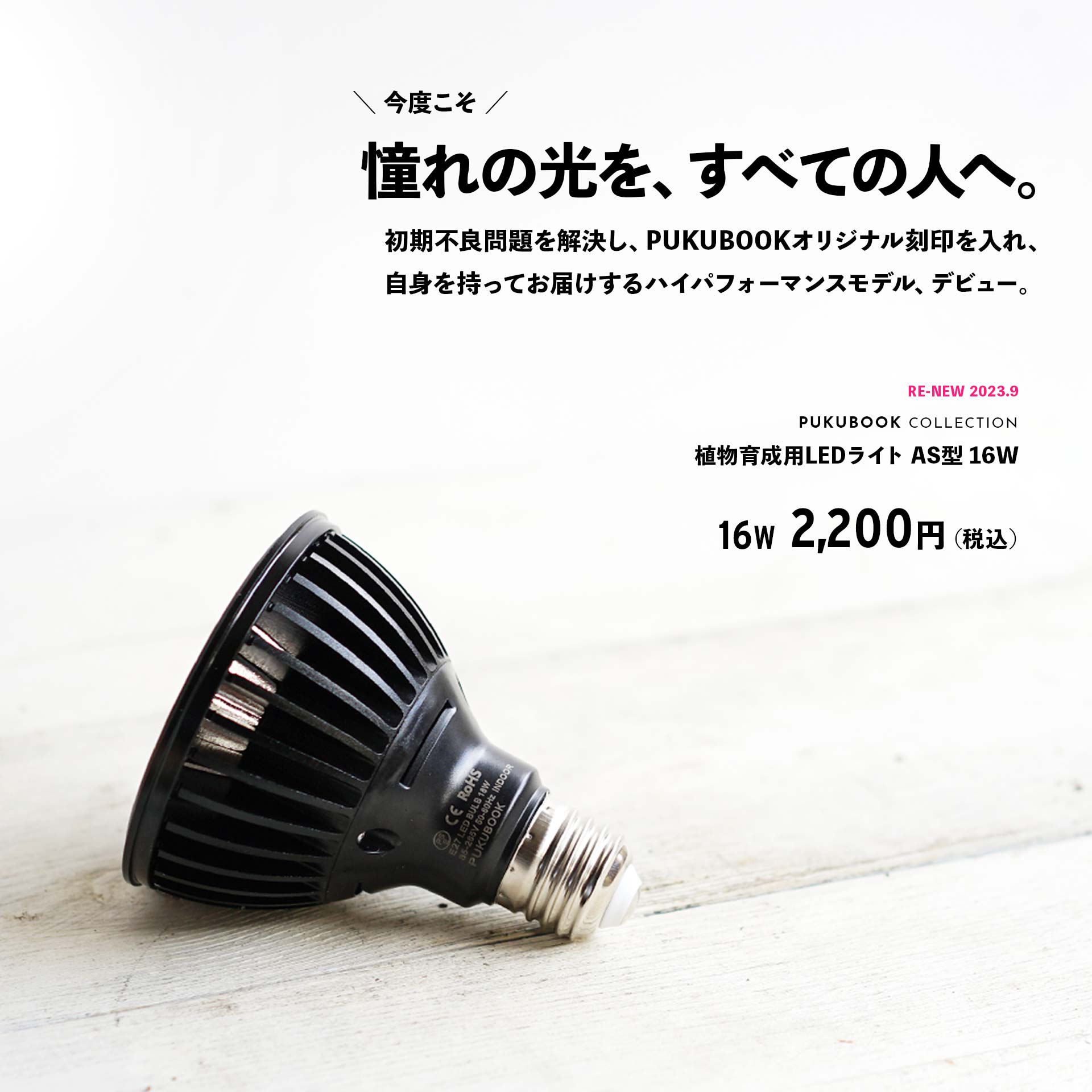
Here’s the AS model we’re featuring this time—the compact type. In truth, I had previously introduced all three models as a "test sale," but now, only the middle 16W version is being "officially released"(the others are postponed for now since they don’t significantly outperform the current AR model…).
The main highlight of this new model is its “small” size. Within its class*, it is the smallest available. Less bulkiness means it doesn’t dominate the space, and since the light source sits slightly higher, you can set it at a comfortably elevated position using a standard stand. Even with a Joseph Iron stand or larger agaves, this should still work perfectly. Using just one bulb and one plant, this model won’t have your light grabbing all the visual attention.
*Compared to other E27-compatible plant growth LED bulbs with similar wattage widely available on Amazon.
Incidentally, the Joseph Iron stand featured here is 1,290 yen at Monotaro, and the cord socket is 839 yen, also at Monotaro. With the AS-type LED bulb for 2,200 yen, the complete set totals 4,329 yen. Pretty realistic, don’t you think?
This time it’s a 16W* model. Since most general LED bulbs are 20W, you might wonder if it’s underpowered. But when you actually measure brightness, the max output is over 800,000 lux—an ultra-high output not easily matched by other bulbs (AR 20W delivers 630,000, the famous A does 330,000). The smaller body may concentrate the light even more. Of course, if you go more than 20cm away, it drops to around 90,000 lux, a bit below the AR model’s 160,000 (the famous A hits about 70,000). Still, I actually think that this level of brightness is ideal for plants, minimizing stress while creating a good environment.
*Originally the official spec was written as 20W, but since the actual wattage is about 14-15W, I independently changed the label to “16W” for sale (I had initially called it 18W but changed my mind…). It isn’t a “lower output” model; rather, I want to emphasize the benefit—it uses over 20% less energy than a 20W bulb.
You can see the growth differences in the photos above. As always, individual variation exists, but 24W showed clear stress coloring, 8W was just a bit leggy and slower to grow, and the famous A was vigorous but a little stressed, too (probably just a specimen difference). In contrast, the 16W model displayed healthy, bright green, sturdy growth. Not just “not a problem”—it really seems like this is the perfect light intensity for raising plants.
#You might wonder: “Don’t 24W and the famous A deliver bigger or healthier plants?” Fair question. Maybe it’s not only individual differences. But today is all about "cost-effectiveness" and "alternatives." So after reading this, if the famous A still seems like the best choice, by all means, go for it! (lol)
#For the record, I tested all lights at 20cm—a bit of a stress point for the 16W model. If you position the 16W between 25–30cm, stress colors should be lessened and you’ll likely see even healthier results.
Here’s a brightness comparison taken at the same camera settings. The 24W is visibly much brighter, and the 8W significantly dimmer. The 16W and the famous A’s 20W look about the same overall, but differ in their coverage—the 16W is brightest in the center, while the famous A gives a more even spread.
Now, I’ve been hyping up “16W is just right!” but does that mean 8W is too weak? Actually, I can’t say it too loudly, but 8W is totally fine. Here’s why!
In fact, at zero distance, the 8W proved powerful enough to bleach Agave leaves. While that was admittedly too close, when I set it 5cm away, the Agave produced strong, firm leaves. For Echeveria, even at a 20cm, slightly off-center position, there was no elongation, just healthy, happy growth. So really, for succulent lighting, 8W works well at 5–30cm and offers a more compact, maneuverable setup compared to the 16W model (which works best at 10–40cm).
So for a single small agave, or with succulents like Echeveria that don’t need super-strong light, 8W is absolutely enough! This "low-light LED" potential is something I’m excited to keep testing and reporting on.
For this “just right” size and power model, I wanted to recommend it right away—but there was one big catch: it had a lot of initial defects.
The first batch I imported had a shocking defect rate of over 30%! (Special thanks to those who bought the "survivors" from last time.) But with the specs and price, I really didn’t want to give up. So I disassembled the bulbs myself, identified the problem, and proposed fixes to the factory. Amazingly, the manufacturer responded to my enthusiasm, agreeing to fix it in the next production run! Of course, it required placing a bigger order than ever before, but I decided to take the plunge. I waited nervously for the next batch, and as you can see in the photos… they achieved a 0% defect rate! Now I can truly recommend these confidently.
For further assurance, we’ve engraved the PUKUBOOK logo on every product. This officially marks the very first original PUKUBOOK-branded item!
#This story may be slightly dramatized for effect.
So what’s the main message?
・Super highly recommended!
・Ordered in huge quantities so running out of stock shouldn’t be an issue
・They’re so affordable, we welcome bulk orders!
Thank you for your support!!
To complement today’s product release, we’re also adding new slotted pots to our lineup. Dedicated succulent lovers may already be importing and using these, but now, thanks to the PUKUBOOK COLLECTION, you can buy small lots with same-day shipping* for even more convenience. I just started using them myself, so I’ll share a review later—though you probably know what to expect already!
I hope you’ll check them out, too.
*PUKUBOOK COLLECTION’s same-day shipping cut-off is about 9AM ((absolute latest is 12PM)), and we can’t guarantee 100% same-day shipping. Thanks for your understanding.
CREATIVE COMMONS BY-NC 2026
PUKUBOOK SOME RIGHTS RESERVED.


BenefitFewer ads for a cleaner display♪