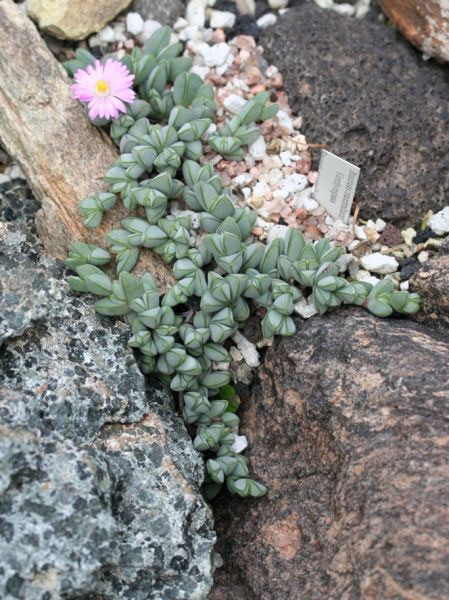
The adorable way these plants look like little fish opening and closing their mouths has made "Hekigyoren" very popular.
It's often introduced as part of the Echinus (Echinos) genus and sometimes as belonging to the Lampranthus genus, but currently, the official classification seems to be in the genus Braunsia.


| Season Type | Winter |
|---|---|
| Sun Exposure | Full Sun |
| Hardiness | -5℃ / 23℉ |
| Blooming Season | Sp Su Fa Wi |
Gray display shows general information for Braunsia.
| Disclaimer & Notice | PUKUBOOK is created and operated by an individual as a hobby. Our basic policy prioritizes "fun" over "accuracy," so please be careful when using or reposting content.For more details on our publication policy, click here |
|---|
This succulent is called "Hekigyoren," thanks to the way its leaves resemble fish opening their mouths wide.
With their translucid green, fish-shaped leaves, matte texture, and clear-lined edges*, these plants look like they're swimming together in style with their orangey-red new stems. It can be hard to see in photos, but a pair of these fishy friends are less than 1 cm across—seriously petite! There are other mesembs with similar looks, but nothing else blends these details quite so perfectly.
*The edge of the leaf is half-transparent, like the "window" seen in Haworthia or Conophytum, so you can see a hint of the succulent tissue inside. The reason they look so clear and see-through is because… they really are!
In fall, they produce shiny purple, daisy-like flowers—the same type of flower as the ice plant. In their native South Africa, they’re apparently called vygie. They naturally grow at elevations around 250–1100m, clinging tight to the ground in half-shaded rocky or gravelly spots. It’s like they use every gap in the rough, stony ground to sprawl and spread.
According to LLIFLE, "It used to be considered Lampranthus, but based on various characteristics*, it is now correctly classified as Braunsia." So where did Echinus come from? The funny thing is, there don't seem to be any references claiming it was actually part of Echinus. Where did that idea even start…? (Apparently, *the absence of spines on the seeds links it to Lampranthus, but features like the shape of the flower and leaves, branching, and the small bumps on the leaf surface all match Braunsia.)
The last character in the Japanese name is sometimes "ren" (to connect) or "hasu" (lotus), and both meanings fit. "Ren" (to link) gets more search hits, but the ICN writes it as "hasu." Even tags from a well-known garden center say "ren."
You might see "Byeok-eo-yeon" (벽어연, byeok-eo-yeon) on Korean plants online—this is just how they read "Hekigyoren" in Korean. Is it the same species? Right now people seem suspicious, so could this be your chance? But is it really the same species? In the end, you can only trust your own eyes!
"Hekigyoren likes water," as the saying goes.
If you don't water it, it wrinkles up right away, and as soon as it's watered it plumps back up. It's super easy—and adorable—to tell whether it's feeling "hungry" or "full!"
So, oddly enough, you actually need a good dose of patience and self-control to hold back on watering (lol).
Even though they're from South Africa, this is a cool-season plant from higher altitudes. It grows actively from fall through spring and puts out new growth around May, but from July it usually stops growing altogether. During that period, it's best to "stop watering completely" and "move to shade." In winter, they're cold-tolerant, but can be damaged by frost—so again, no watering is recommended.
Wait, really? No water at all, even when it’s all shriveled and thirsty? Yep—you'll need real willpower to do this!
In reality, depending on light and such, they can truly go a whole month without water. Native habitat photos show them often wrinkly, so maybe that's just their natural default. Still, it feels so sad… (sweat)
I confess—I just couldn’t keep mine dry for so long! From my own experience, with enough sunlight and the right watering, you’ll be okay. That said, in summer, only water late at night or in the early morning, preferably just before a cool or cloudy period. Especially during the intensely hot Obon festival weeks (2–3 weeks in August), stop watering altogether. Timing is everything!
I wrote above that it grows in half-shade, but during its growth season, full sun almost all day is fine. In fact, some sources say "giving it as much sun as possible in non-summer and non-winter periods is key to getting it through summer and winter." Even when you want to bring it indoors during summer heat, don't keep it in the dark or it won’t thrive later. So actually, keeping it outside, out of the rain, in full sun with no water, gives you the healthiest plant.
You can propagate from cuttings. Instead of cutting right away, place the tip you want to cut directly on soil for a while—roots will emerge from under the leaves and they'll settle in, for a much more reliable start.
There are several similar plants or ones with "Hekigyoren"-like names.
Ruschia indurata R. indurata , also known as "Mini Hekigyoren." Its leaves are similar in design, but the whole plant is even smaller, less than half the size.
Braunsia apiculata B. apiculata . The leaves look almost identical, but from afar it's upright and the leaves are flattened, so it has quite a different presence.
Gibbaeum petrense G. petrense . Its leaves are a bit bigger and it doesn't branch, so the effect is matte, solid, and rugged.
Corpuscularia lehmannii C. lehmannii . These leaves don't have the distinct margins; they're even more matte and solid and a bit larger, too. It often grows upward (some Hekigyoren do, too), will stretch its leaves if it doesn’t get enough sun, and its flowers are yellow.
Astridia velutina A. velutina . Looks a lot like lehmannii, but with white flowers.
Echeveria imbricata (E. glauca x E. gibbiflora 'Metallica') 七福神ってEcheveria imbricataなんかい。赤くなる?ニュージーランドのは葉の先の方が赤くなるよ。 Braunsia maximiliani 日本の碧魚連って大きめなのね。 栄養状態がいい間だけかな。 小さい方が好み。 https://t.co/yXyXuIIkwo
@HobbyistPlant Found it! It's in the hashtag on the original post. ID : Braunsia Maximiliani (Beads Lampranthus)
Braunsia maximiliani seeing as it's #MesembMonday. It got one pink flower this winter but it was a bit underwhelming. #mesembs #succulents #braunsia https://t.co/RUaR3ZbkGf
#Braunsia_maximiliani 碧魚連 1, 2枚目は大きめの素焼きボウルで、3枚目は育苗トレイで育っています。 どちらの色合いがお好きですか? Pic 1 & 2 are growing in a large terracotta bowl. Pic 3 are cuttings growing in a seedling tray. #多肉植物 #melon_cactus https://t.co/CzGdwE0uHL

CREATIVE COMMONS BY-NC 2026
PUKUBOOK SOME RIGHTS RESERVED.


BenefitFewer ads for a cleaner display♪